Bedroom Design · Foundations
Choosing a Platform Bed Frame: Support, Materials, and Room Fit
A bed frame is more than a border around a mattress. It is the structure that carries nightly weight, influences how a room feels, and determines whether the space beneath the bed is useful, hidden, or simply hard to reach. A platform frame can simplify that structure—but only when its support, dimensions, and construction suit the mattress and the room.
In a quiet bedroom, the platform bed can seem almost inevitable: a mattress resting on a low, clean-lined base, with no separate box spring in sight. The simplicity is practical, but it can conceal important differences. Some platforms use closely spaced slats; others rely on a solid deck or a combination of rails and center supports. The frame’s materials, joints, height, and footprint all help determine how it performs over time.
Choosing among platform bed frames therefore begins with a few questions that are less about appearance than fit. What does the mattress maker require beneath the mattress? How much clearance does the frame leave for cleaning or storage? Can the bed’s full dimensions fit comfortably through the bedroom and around its furniture? And will the construction remain stable under ordinary use?
These considerations apply whether you are furnishing a compact apartment, planning a calm coastal-inspired bedroom, or comparing a frame from a regional maker such as Maple Corner Woodworks with other options. The aim is not to find a universally perfect bed, but a foundation that works with the mattress, the room, and the habits of the people who use it.
What makes a platform bed different?
A platform bed is designed to support a mattress directly on its own base. That base may consist of a solid panel, a slatted surface, or a structured combination of slats, rails, and crosspieces. Because the frame is intended to provide the supporting surface, a separate foundation may not be needed. This differs from a traditional bed frame that supports a box spring or another foundation, which in turn supports the mattress.
The term “platform” does not describe one exact construction. A low-profile frame and a taller model may both be platform beds, while their internal support systems differ considerably. One frame may have a continuous deck; another may have widely spaced slats; a third may include a center beam with additional legs. Those distinctions matter because the mattress is in direct contact with the base.
Before assuming a platform eliminates every other foundation, read the mattress manufacturer’s requirements. Some mattresses specify a maximum distance between slats, require a particular type of base, or set conditions for warranty coverage. A solid surface may suit one mattress but restrict airflow compared with a slatted design. Compatibility is not a decorative detail: it is the starting point for a sound decision.
Support begins beneath the mattress
Mattress support depends on how evenly the base carries weight. With slats, their spacing, width, thickness, and attachment all contribute. Slats that are too far apart for a particular mattress can leave areas with less support than intended. Slats that shift, bow, or lift out of position may also produce an uneven surface. A solid deck avoids gaps between slats, but it has its own considerations, including ventilation and the mattress maker’s guidance.
Look beyond a product photograph. Ask for the distance between slats and whether the frame includes a center rail. For wider sizes, a central beam and its supporting legs can help carry the load across the span. The exact design varies by frame and size, so verify the details for the version you are considering rather than relying on assumptions about the category as a whole.
Construction deserves close attention, too. Strong connections between side rails, headboard, footboard, and central supports help the frame behave as a single structure. Hardware should be secure and accessible for assembly. If the design uses wood joinery, ask how the frame is assembled and whether it is intended to be taken apart and moved. A bed that feels steady in a showroom or listing description still needs to be assembled correctly on a level floor.
Stability is not the same as firmness in a mattress. The frame supports the mattress; it does not replace a mattress chosen for personal comfort. A sturdy base can help provide an even foundation, but it cannot correct a mattress that is unsuitable for a sleeper’s preferences or needs.
Slatted, solid, or a combination?
Each base design brings a different balance of support, airflow, weight, and maintenance. A slatted platform leaves open spaces beneath the mattress. That can make the structure lighter and allow air to move through the base, though actual ventilation depends on the room, mattress, bedding, and surrounding conditions. Slats must be spaced in accordance with the mattress requirements and secured so they stay in place.
A solid platform offers a continuous supporting surface. It can create a simple, stable base, but a nearly closed surface may permit less airflow beneath the mattress. Check both the mattress instructions and the frame’s design before choosing this arrangement. The surface should also be inspected for smoothness and structural integrity, particularly at joints and edges.
Some frames combine a slatted surface with a center support or other reinforcement. This can distribute weight across a broader frame, especially for larger sizes, while keeping the base open. Still, labels alone do not establish suitability. The useful questions are specific: What is the slat spacing? How many support points are present? Is the base designed for the mattress type and size?
- For slats: confirm spacing, width, attachment, and center support where applicable.
- For a solid deck: check mattress compatibility and consider ventilation guidance.
- For either design: ask whether the specified support applies to your chosen bed size.
When product details are incomplete, contact the manufacturer or retailer before purchasing. A brief confirmation can prevent the inconvenience of discovering that a frame and mattress are not intended to work together.
Materials shape longevity and character
Wood and metal are common frame materials, and each can work well when thoughtfully constructed. With wood, species, component thickness, joinery, finish, and craftsmanship all matter. A solid-wood frame may show natural variation in color and grain; this is part of the material’s character, not necessarily a defect. The finish can affect appearance and routine care, so find out how the surface should be cleaned and maintained.
Metal frames can offer a different visual language and may be relatively straightforward in design. Their performance depends on the construction, connections, and support layout, just as a wooden frame’s does. For either material, inspect the points where components meet. Ask how the frame is assembled, whether hardware is included, and whether replacement parts or assembly instructions are available.
Responsible material sourcing may be important to some households. If sustainability is a priority, look for clear, specific information about the materials and their origin rather than relying on broad language alone. A finish described as hand-applied or low-impact should be understood through the maker’s own documentation. Durability also matters: a well-maintained frame used for many years can be a practical choice, but longevity cannot be guaranteed by material labels alone.
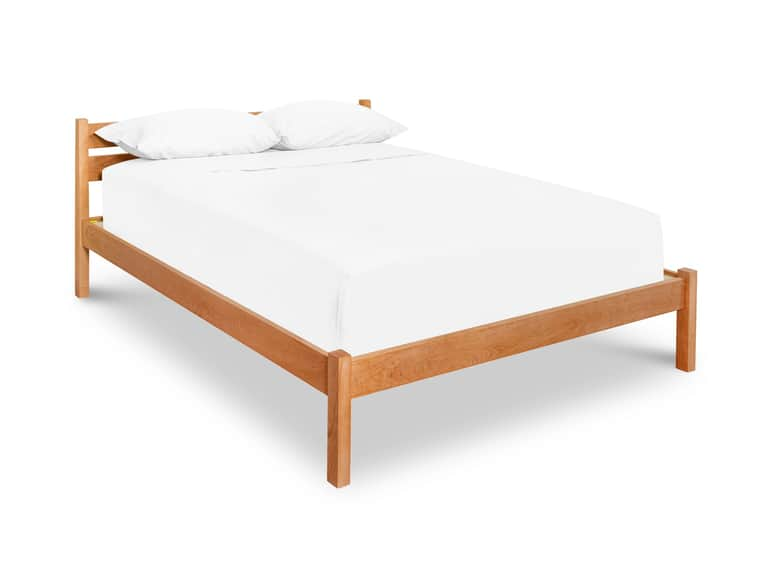
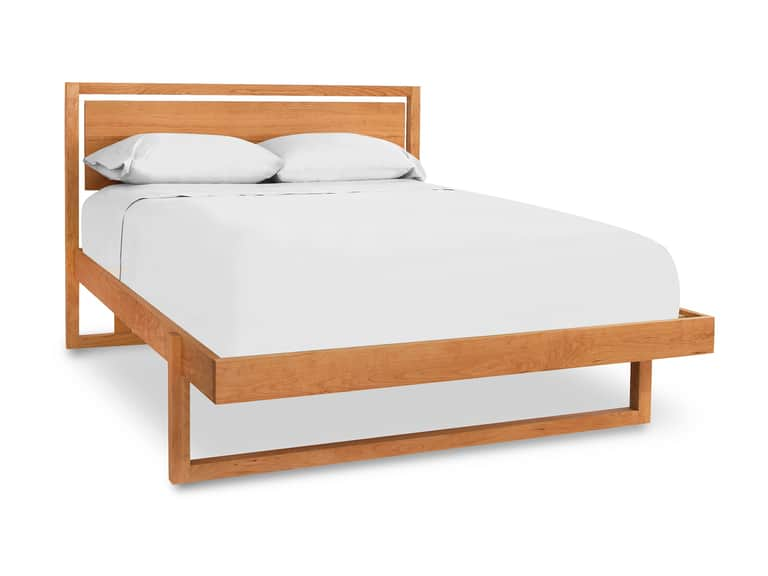
For a solid-wood example, the Vergennes Platform Bed is described as a handcrafted platform bed made from solid wood, with a natural hand-rubbed oil finish and Vermont origin. Its listed crafting time is 16–20 weeks. Those details may help a reader compare material and lead-time expectations, but they do not replace checking the exact size, support specifications, finish options, or compatibility with a particular mattress.
Measure the room, not just the mattress
A mattress size is only one part of the bed’s footprint. The outer dimensions of the frame may extend beyond the mattress, especially where a headboard, footboard, or wide rails are present. Before ordering, find the frame’s full assembled measurements and compare them with the bedroom’s usable floor area.
Measure the space between walls, doors, windows, closets, and other furniture. Consider how the door swings and whether drawers, wardrobe doors, or bedside tables need clearance. A bed can technically fit while leaving too little room to walk around it comfortably. In a smaller room, even a modest difference between mattress dimensions and frame dimensions can influence whether a nightstand fits or a closet remains easy to reach.
Also plan the route into the room. Measure narrow hallways, stairwells, turns, and door openings. A frame that arrives in pieces may be easier to maneuver than one with large assembled components, but packaging dimensions and assembly requirements vary. If delivery involves stairs or tight corners, ask the seller about the largest pieces and the recommended access measurements.
A quick floor plan can clarify the choice. Mark the bed’s outside dimensions, then leave space for movement and essential furniture. Painter’s tape on the floor can help you see the footprint before committing. This simple test reveals how the bed will divide the room, whether it blocks a radiator or outlet, and whether there is enough clearance to make the bed easily.
Height, clearance, and daily use
The total height of a platform bed depends on the frame, mattress, and any approved topper or pad. A low frame can create a visually open, grounded appearance, while a taller arrangement may make getting in and out easier for some people. Neither height is automatically better. Think about the sleeper’s comfort, the mattress thickness, and how the bed will be used day to day.
Clearance beneath the frame is a practical decision with consequences for cleaning and storage. A raised bed may allow access for a vacuum or offer room for storage containers. A low base can reduce visible clutter and may suit a streamlined bedroom, but it may leave little space beneath. Check the measurement from the floor to the lowest rail or support—not simply the height to the mattress surface.
If using under-bed storage, measure the containers as well as the opening. Remember that a frame’s central legs or cross-supports may divide the available area. Storage should not obstruct structural supports or make it difficult to clean beneath the bed. In a coastal-inspired room, an uncluttered floor can contribute to a light, calm atmosphere; practical clearance is one way design and maintenance meet.
Match the frame to the room’s design
The bed usually occupies the largest uninterrupted area in a bedroom, so its silhouette strongly influences the room. A low, simple platform can make a compact space feel less crowded. A pronounced headboard or high footboard can give a larger room a clear focal point, but it may also add visual weight and affect circulation.
Material and finish help establish the atmosphere. Visible wood grain can bring warmth and texture; painted or upholstered surfaces may read more softly or formally. For coastal-inspired interiors, calm colors and natural materials can echo light, sand, and weathered surfaces without turning the room into a literal theme. The most comfortable spaces often use a restrained palette and rely on texture rather than ornament.
Consider how the bed relates to existing furniture. The headboard’s height may affect a window, artwork, or wall-mounted lighting. Rail width can change the apparent scale of the mattress. A footboard can define the bed but may be inconvenient in a narrow route between the bed and a wall. Design should serve movement as well as appearance.
A practical comparison checklist
When comparing platform bed frames, record the details in one place. Specifications can be easy to overlook when product descriptions emphasize style, and side-by-side notes make meaningful differences clearer.
- Mattress requirements: confirm that the mattress may rest directly on the frame and check any base or warranty conditions.
- Support design: note whether the base is solid, slatted, or combined; record slat spacing and center support details.
- Frame dimensions: compare full exterior width, length, and height with the room and mattress.
- Under-bed clearance: measure the lowest point and consider cleaning, storage, and access.
- Materials and finish: identify the frame material, finish, care instructions, and any sourcing information that matters to you.
- Assembly and moving: check what tools are required, how components connect, and whether the frame can be disassembled.
- Delivery timing: confirm lead time, delivery method, and access requirements, especially for made-to-order furniture.
- Stability details: ask about rails, center beams, legs, and the support configuration for your selected size.
For a straightforward comparison, prioritize the non-negotiables first: mattress compatibility, room fit, and adequate support. Once those conditions are satisfied, materials, finish, height, and style can guide the final choice.
Common mistakes to avoid
One frequent mistake is choosing by appearance before checking the support surface. A beautiful frame may not be appropriate for a particular mattress if the slats are too widely spaced or the base otherwise conflicts with the manufacturer’s requirements. Verify specifications before ordering.
Another is measuring only the mattress. The frame’s rails and headboard can add several inches to the footprint, and the delivery route may be tighter than the bedroom itself. Measure both the installed space and the path the parts must travel.
It is also easy to treat “solid wood,” “platform,” or “handcrafted” as complete descriptions of performance. These terms do not tell you everything about slat spacing, center support, finish care, assembly, or suitability for your mattress. Ask for the details that affect your situation.
Finally, avoid assuming that more storage or more height is always useful. A tall frame may complicate access for some sleepers; a low frame may make cleaning harder. The right choice reflects real routines, not an abstract ideal of bedroom design.
A foundation for a better-fitted room
A platform bed frame brings together structure and setting. Beneath the mattress, the base must meet the mattress maker’s support requirements. Around it, the frame must fit the room without crowding the paths people use. At the surface, its material and finish contribute to the bedroom’s everyday character.
Begin with measurements and compatibility, then compare construction, clearance, and materials. Ask precise questions where specifications are unclear, and consider how assembly and delivery will work in the actual home. These steps turn a broad search for a bed frame into a more useful assessment of the particular bedroom.
The result need not be elaborate. A well-chosen platform frame can provide a clear, dependable base and let the room breathe around it. In the stillness of evening, that quiet practicality is part of the design: a structure doing its work unobtrusively, night after night.